First place in the 2026 final-year project competition at Carinthia University of Applied Sciences
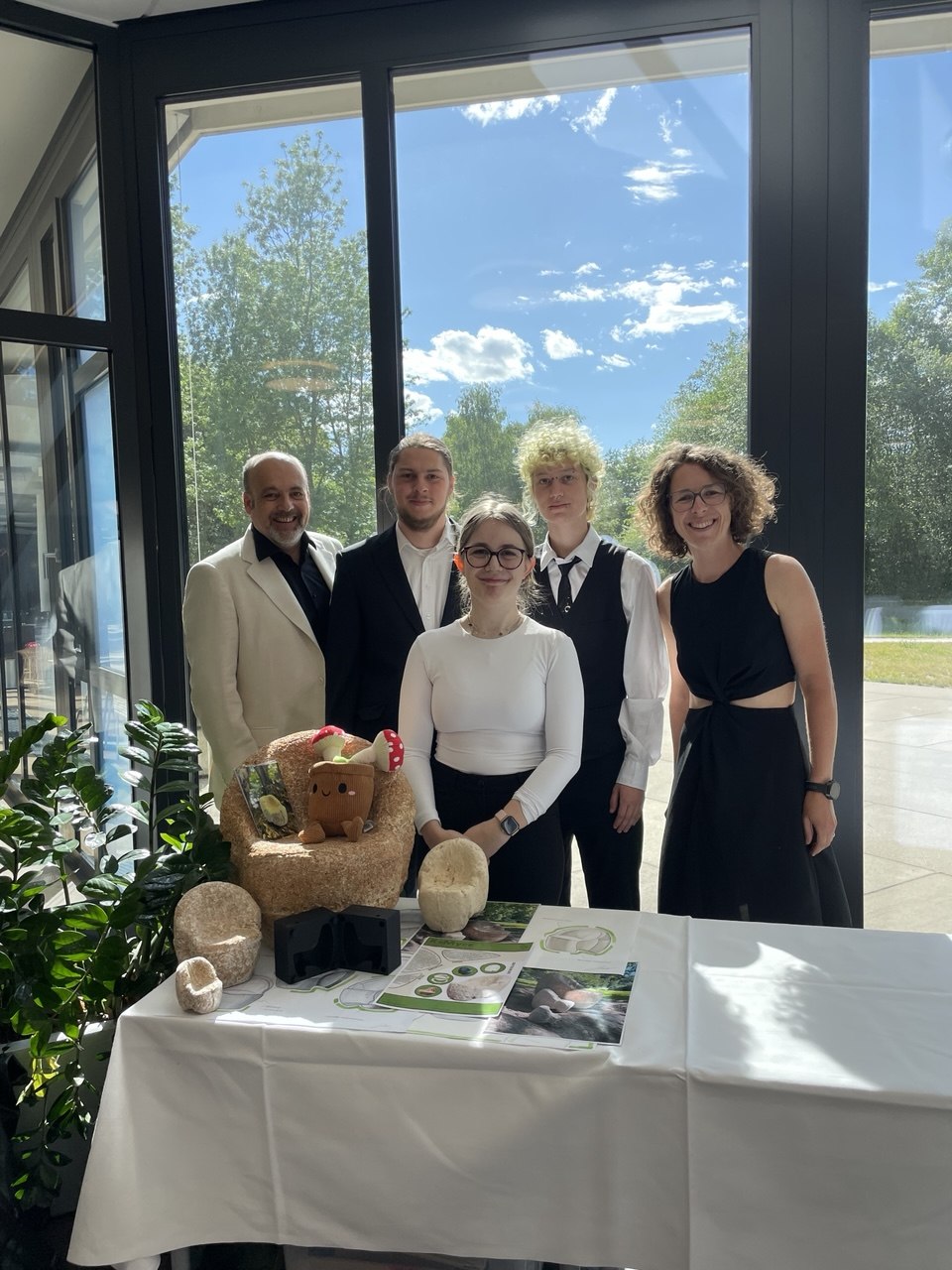
Special recognition goes to Anika Bachmayer, Kathrina Galla and Paul Kindermann, whose work won first place in the final-year project competition at Carinthia University of Applied Sciences.
At HTL Villach, the project was supervised internally by VOL Bernd Santner, BEd. External academic and scientific guidance was provided by Anja Boisselet, MSc, and DI Mag. Peter Piccottini of the Scientific Society bionikum:alpen-adria and brain rooms synapsis.
The result confirms an early assessment of the team’s potential. Despite differing starting points and initial uncertainty, the students developed noticeably in academic, methodological and personal terms throughout the project.
Their research and presentation were highly professional. The jury from the Civil Engineering and Architecture department at Carinthia University of Applied Sciences recognised this quality. The team prevailed over 27 projects submitted from across Austria in its category.
The winning project reached a level of technical depth, methodological consistency and scientific rigour comparable to a master’s thesis. Its maturity left a lasting impression on the jury.
The specialist expertise of the external team from bionikum:alpen-adria made an important contribution. The guidance of Anja Boisselet and Peter Piccottini sharpened both the subject matter and the scientific argument.
The success of Anika Bachmayer, Kathrina Galla and Paul Kindermann reflects expertise, perseverance, teamwork and a serious commitment to research.
Read more
ReMyce was also selected for support through the Austrian innovation programme innovations@school. The programme promotes school projects in applied research and cooperation with external partners. It particularly recognised the connection between sustainable materials, technical development and social relevance.
Close cooperation with Bionikum has been central to the project. As an initiator and scientific partner in Biomimetics, it accompanied the development process and connected biomimetic methods with practical materials research beyond the usual boundaries of a school project.
ReMyce represents a form of final-year project conceived as active research rather than a record of acquired knowledge. The students address real questions in materials development, test prototypes and analyse growth processes. Their work asks how architecture and product design might use living or biologically grown materials in the future.
Beyond the awards, the project points to a wider development: schools are becoming places of genuine innovation. ReMyce shows how an idea can grow into a research-based prototype through curiosity, scientific method and a commitment to sustainable living environments.
Its success at Carinthia University of Applied Sciences and innovations@school demonstrates the value of connecting education, research and sustainable transformation. It also reveals the potential of a new generation of researchers and developers.